This notebook is available on GitHub.
Interactive online version:

Fit a line to data
[6]:
import numpy as np
import matplotlib.pyplot as plt
import alabi
from alabi.core import SurrogateModel
import alabi.visualization as vis
from functools import partial
Generate some synthetic data from the model
[7]:
a_true = 2.0
b_true = 1.5

# Define the bounds for the input (a and b)
bounds = [(1.5, 2.5), (1, 2)]

np.random.seed(0)
x = np.sort(10*np.random.rand(50))
yerr = np.random.rand(50)
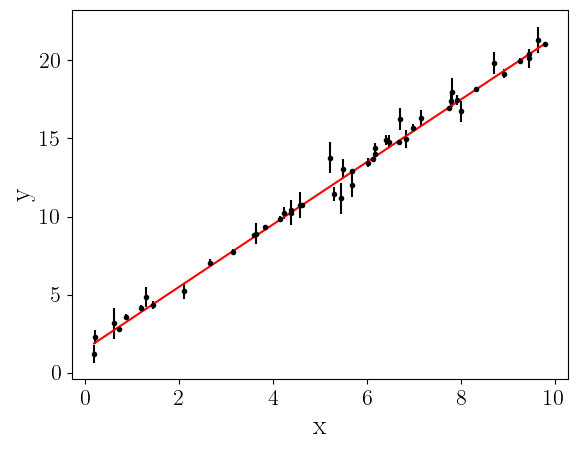
y = a_true*x + b_true + yerr*np.random.randn(50)

plt.errorbar(x, y, yerr=yerr, fmt="k.")
plt.plot(x, a_true*x + b_true, "r-", label="True line")
plt.xlabel("x", fontsize=20)
plt.ylabel("y", fontsize=20)
plt.show()
Define the likelihood function
[8]:
def lnlike(theta, x, y, yerr):
    a, b = theta
    ypred = a * x + b
    lnl = -0.5 * np.sum(((y - ypred)**2) / (yerr**2))
    return lnl

lnl = partial(lnlike, x=x, y=y, yerr=yerr)
[9]:
lnl([a_true, b_true])
[9]:
np.float64(-30.033423563056278)
Train the surrogate model
[ ]:
# Create the surrogate model
sm = SurrogateModel(lnlike_fn=lnl, bounds=bounds, savedir="results/linear_fit", random_state=42)

# Initialize samples
sm.init_samples(ntrain=200, sampler="sobol")

print("Data diagnostics:")
print(f"  theta shape: {sm.theta_train.shape}")
print(f"  y shape: {sm.y_train.shape}")
print(f"  y range: [{sm.y_train.min():.3f}, {sm.y_train.max():.3f}]")
print(f"  y std: {sm.y_train.std():.3f}")

gp_kwargs = {"kernel": "ExpSquaredKernel",
             "fit_amp": True,
             "fit_mean": True,
             "fit_white_noise": False,
             "white_noise": -8,
             "gp_opt_method": "l-bfgs-b",
             "gp_scale_rng": [-2,1],
             "optimizer_kwargs": {"max_iter": 50, "xatol": 1e-3, "fatol": 1e-3, "adaptive": True}}

al_kwargs={"algorithm": "bape",
           "gp_opt_freq": 20,
           "obj_opt_method": "nelder-mead",
           "nopt": 1,
           "optimizer_kwargs": {"max_iter": 50, "xatol": 1e-3, "fatol": 1e-2, "adaptive": True}}

# Initialize the Gaussian Process (GP) surrogate model
sm.init_gp(**gp_kwargs)

# Train the GP surrogate model with conservative settings
sm.active_train(niter=100, **al_kwargs)
[11]:
sm.true_log_likelihood([a_true, b_true]), sm.surrogate_log_likelihood([a_true, b_true])
[11]:
(np.float64(-30.033423563056278), np.float64(-30.03630764913396))
Plot some diagnostics
[12]:
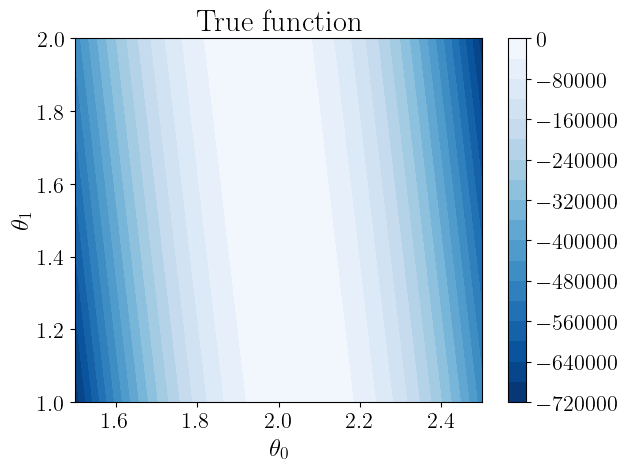
sm.plot(plots=["true_fn_2D"])
Plotting true function contours 2D...
Saving to  results/linear_fit/true_function_2D.png
Saving to  results/linear_fit/true_function_2D.png
Plotting true function contours 2D...
Saving to  results/linear_fit/true_function_2D.png
Saving to  results/linear_fit/true_function_2D.png
[12]:
[13]:
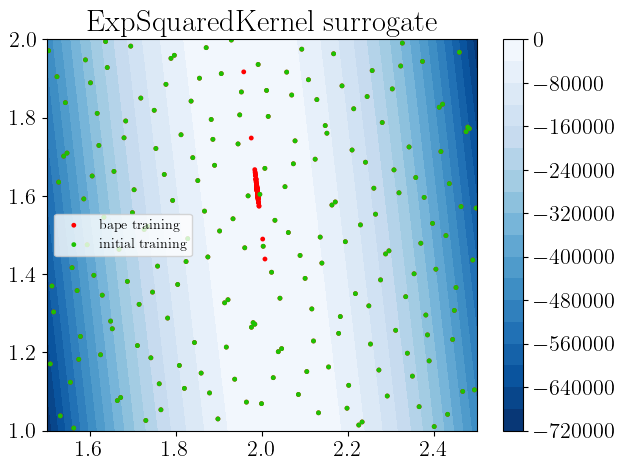
sm.plot(plots=["gp_fit_2D"])
Plotting gp fit 2D...
Plotting gp fit 2D...
[13]:
[14]:
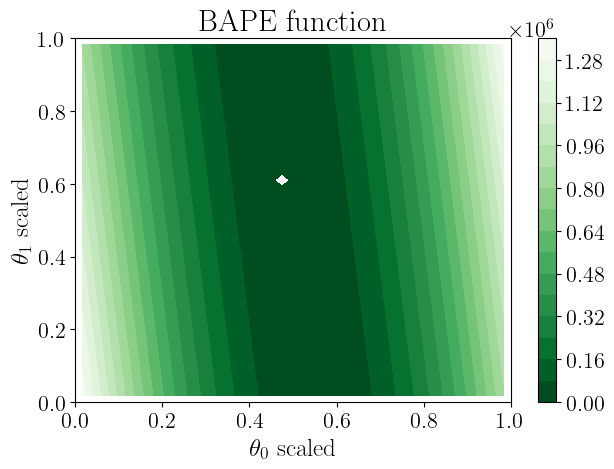
sm.plot(plots=["obj_fn_2D"])
Plotting objective function contours 2D...
Plotting objective function contours 2D...
Saving to  results/linear_fit/objective_function.png
[14]:
[15]:
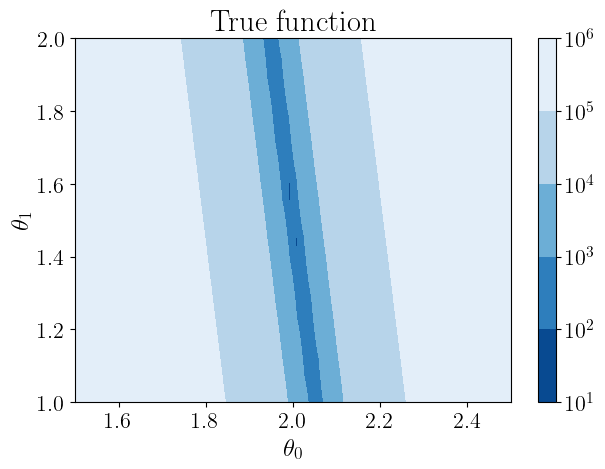
nll_true = lambda *args: -sm.true_log_likelihood(*args)
vis.plot_contour_2D(nll_true, sm.bounds, sm.savedir, "true_function.png",  title="True function", ngrid=60,
                    xlabel=sm.param_names[0], ylabel=sm.param_names[1], log_scale=True)
Saving to results/linear_fit/true_function.png
[15]:
[16]:
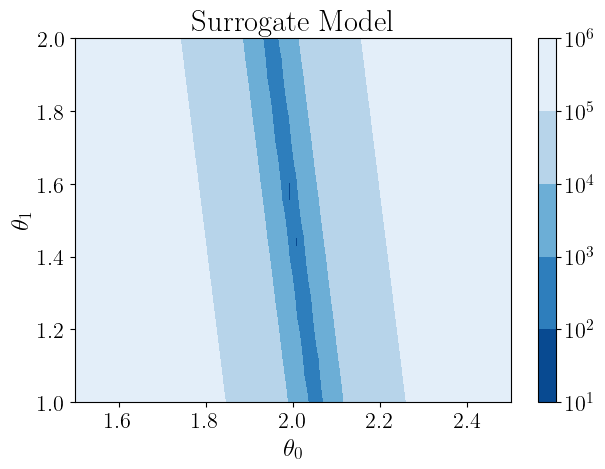
nll_pred = lambda *args: -sm.surrogate_log_likelihood(*args)
vis.plot_contour_2D(nll_pred, sm.bounds, sm.savedir, "surrogate_model.png", title="Surrogate Model", ngrid=60,
                    xlabel=sm.param_names[0], ylabel=sm.param_names[1], log_scale=True)
Saving to results/linear_fit/surrogate_model.png
[16]:
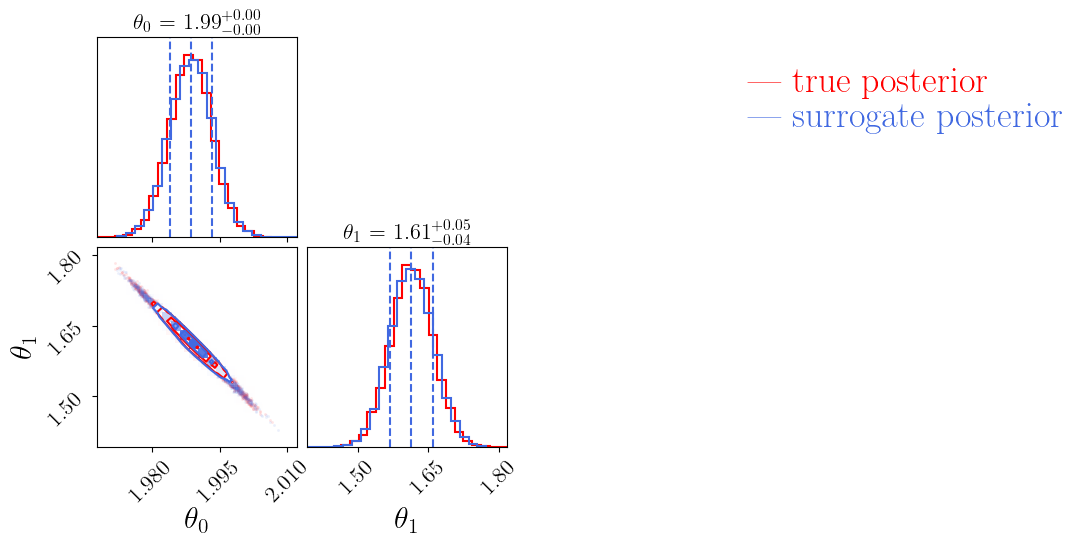
Now let’s compare how MCMC samples from the true function compare to samples from the alabi surrogate model:
[ ]:
sm.run_dynesty(like_fn=sm.true_log_likelihood)
sm.run_dynesty(like_fn=sm.surrogate_log_likelihood)
[19]:
vis.plot_mcmc_comparison(sm.dynesty_samples_true, sm.dynesty_samples_surrogate,
                     param_names=sm.param_names, lw=1.5, colors=["red", "royalblue"],
                     name1="true posterior", name2="surrogate posterior",
                     savedir=sm.savedir, savename="mcmc_comparison.png");
Saving to  results/linear_fit/mcmc_comparison_true posterior_surrogate posterior.png
Saving to  results/linear_fit/mcmc_comparison_true posterior_surrogate posterior.png
[20]:
afit, bfit = np.mean(sm.dynesty_samples_surrogate, axis=0)

plt.errorbar(x, y, yerr=yerr, fmt="k.")
plt.plot(x, a_true*x + b_true, "r-", label="True line")
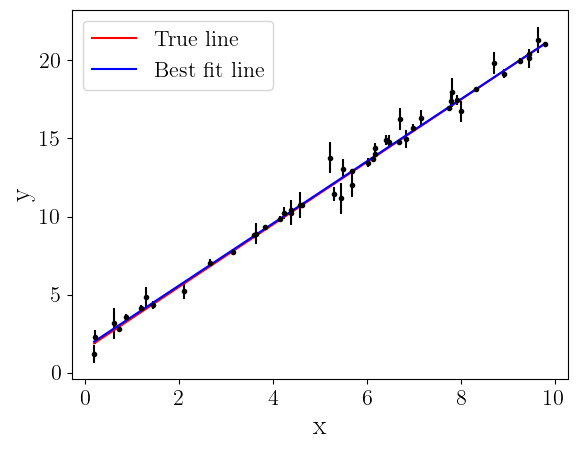
plt.plot(x, afit*x + bfit, "b-", label="Best fit line")
plt.legend(loc="upper left", fontsize=16)
plt.xlabel("x", fontsize=20)
plt.ylabel("y", fontsize=20)
plt.show()